
If you’re planning a trip to Tuscany, you’ve probably seen hundreds of tours that promise “authentic experiences,” “hidden gems,” and “local culture.” After years of organizing, guiding, and participating in tours across Tuscany, I’ve learned that authenticity isn’t a marketing slogan. It’s something you can immediately feel when you’re experiencing it.
I’ve worked with countless travelers looking for the “real Tuscany.” Interestingly, the places they remember most aren’t always the famous landmarks. They’re the conversations with local people, the small family-run wineries, the artisan workshops, and the unexpected moments that simply can’t happen when you’re traveling with dozens of other tourists.
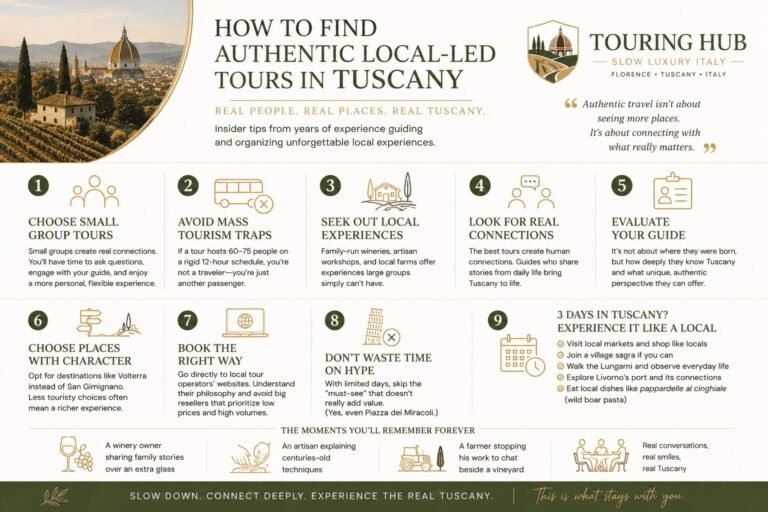
If your goal is to experience Tuscany beyond the typical tourist itinerary, here are the principles I believe matter most.
Authentic Doesn’t Mean Hidden
One of the biggest misconceptions I see is that authentic travel means avoiding every famous destination. That’s not true. Florence, Siena, and many of Tuscany’s iconic towns are famous because they’re extraordinary. Their popularity doesn’t make them less authentic. What matters is how you experience them. I’ve guided travelers through world-famous places that felt deeply personal because we had the time to slow down, ask questions, meet local people, and enjoy the experience instead of rushing from one photo stop to another. The destination is only part of the story. The guide, the pace, and the people you meet are what create authenticity.Why Small Groups Make All the Difference
If I could give only one piece of advice, it would be this: Choose small-group or private tours whenever possible. Over the years, I’ve organized many tours and joined countless others. The single biggest factor that changes the quality of an experience isn’t the itinerary. It’s the size of the group. Large tours often operate with 50, 60, or even 70 guests. There’s nothing inherently wrong with that, but those tours have very different priorities. Their schedules are built around moving large numbers of people efficiently. Stops are shorter, flexibility disappears, and individual conversations become almost impossible. Many travelers end up feeling like passengers on a bus instead of participants in an experience. Small groups create the opposite environment.- There’s room for conversation.
- There’s room for spontaneity.
- There’s room to adapt the day if something interesting happens.
The Experiences I’ll Never Forget
Some of the most memorable experiences I’ve shared with travelers weren’t planned at all. One afternoon, while driving through the Tuscan countryside on quiet back roads far from the main tourist routes, we met a farmer inspecting his vineyards. He wasn’t expecting visitors. He wasn’t selling anything. He simply stopped to talk. He shared what life was like during the growing season, explained how the weather affected the grapes, and spoke about his family’s daily routine. Those twenty minutes taught my guests more about Tuscany than any scripted presentation ever could. Moments like that only happen when you’re not rushing to keep a bus schedule.Authentic Places Are Often Too Small for Mass Tourism
Many of the experiences I recommend simply couldn’t work with large groups. One example is visiting a small family-run winery where every guest receives personal attention. Instead of tasting wine in a room filled with dozens of tourists, you sit with the people who actually produce it. You hear their stories, learn about their traditions, and understand the work behind every bottle. I’ve also taken travelers to artisan workshops where local craftsmen still create traditional Florentine frames or produce commesso fiorentino, the centuries-old art of Florentine stone inlay. These aren’t attractions built for tourism. They’re real workplaces. Large groups would interrupt the artisans’ work. Small groups allow visitors to observe respectfully while gaining a genuine appreciation for the skill, patience, and craftsmanship involved.How I Recognize a Truly Local-Led Tour
People often ask me what makes a tour genuinely local. Interestingly, I don’t think it’s simply about where the guide was born. I’ve met outstanding guides who originally came from other countries but have spent decades living in Tuscany, building relationships, understanding local traditions, and becoming part of the community. Likewise, being born in Tuscany doesn’t automatically make someone a great guide. What matters is the guide’s connection to the region.- Can they share personal stories?
- Can they introduce you to local people?
- Can they explain traditions from experience rather than from a script?
Don’t Assume the First Results Are the Best
One mistake I see travelers make repeatedly is booking the first experience they find on the largest online marketplaces. Those tours aren’t necessarily bad. But the tours that appear first are often the ones designed to sell in high volume. That usually means larger groups and standardized itineraries. Another clue is price. If a full-day tour seems unusually inexpensive, ask yourself how that’s possible. Quality guides, transportation, local experiences, and enough time for personal attention all have costs. Very low prices are often made possible by filling buses with 60 or 70 passengers. For some travelers, that’s perfectly acceptable. But if you’re searching for authentic local experiences, it’s usually worth looking beyond the cheapest option.Visit the Company’s Website Before Booking
Whenever I’m evaluating a tour company, I always recommend visiting their own website. The website often reveals far more than a booking platform. Ask yourself:- Do they explain why they created these experiences?
- Do they introduce the people behind the company?
- Do they describe their relationships with local wineries, artisans, or communities?
- Do they explain what makes their approach different?
Sometimes the Less Famous Choice Is the Better One
Popularity isn’t always the best indicator of quality. Take San Gimignano and Volterra as an example. Both are beautiful medieval towns. Both deserve a visit. But depending on what you’re looking for, Volterra often offers a quieter atmosphere, fewer crowds, and a stronger sense of everyday local life. Choosing a destination that’s slightly less famous can sometimes create a much richer experience.My Unpopular Opinion About Tuscany
If you only have a few days in Tuscany, I don’t believe you should feel obligated to visit every famous landmark. For example, many itineraries include a quick stop at Piazza dei Miracoli in Pisa. It’s undeniably beautiful. But if your schedule is limited, I’d rather spend that time enjoying a long lunch in the countryside, visiting a family-run winery, exploring a local market, or talking with artisans who still practice traditional crafts. Travel isn’t about collecting photos. It’s about collecting experiences you’ll still remember years later.What I’d Recommend If You Only Had Three Days in Tuscany
If one of my friends had only three days to discover Tuscany, I’d encourage them to experience everyday local life as much as possible.- Visit regional farmers’ markets.
- Shop in neighborhood supermarkets instead of souvenir stores.
- Attend a local sagra if one is taking place.
- Walk along Florence’s Lungarni and simply observe daily life.
- Visit the port of Livorno to better understand Tuscany’s connection with the rest of Italy.
- Try traditional dishes that locals actually eat, such as pappardelle al cinghiale, rather than chasing foods that became famous on social media.